
.png?width=940&height=788&name=Our%20Client%20Promise%20(7).png)
Industry
Life Sciences
Challenge
Due to its acquisition-based growth strategy, the organization faced significant inconsistencies in job design and compensation management. An initial attempt to implement a new job framework was unsuccessful, prompting the organization to seek Novo Insights' expertise for a more effective solution.
Results
After a stalled internal rollout and lingering skepticism from a prior attempt, Mesa Labs needed more than a new compensation framework. They needed confidence that the process itself could hold. Through a partnership with Novo Insights, the leadership team validated the market data against the organization's own compensation philosophy, co-developed the structure rather than receiving it as a finished product, and rolled it out with tools that equipped managers to champion the change. With a unified global framework now in place across 15 countries, Mesa Labs can make consistent pay decisions across roles and regions and integrate future acquisitions without rebuilding from scratch.
Services
Compensation Foundations

About the Client
Mesa Labs is a global manufacturer of quality control and calibration solutions, supporting customers in highly regulated industries where precision, reliability, and compliance are critical. The company's workforce spans highly technical and specialized roles across 15 countries, built largely through a steady track record of acquisitions. Each acquisition brought new job structures, new titling conventions, and new compensation practices. Over time, the inconsistencies compounded into something that could no longer be managed around.The Challenge
Growing through acquisitions had fueled Mesa Labs' success, but it also introduced complexity. Job design and compensation practices varied widely across the organization.
Eager to bring consistency and fairness to compensation, Mesa Labs took the initiative to build a new job framework. Yet despite the effort, the rollout met resistance and eroded confidence. Feedback from leaders and employees signaled that the framework was too difficult to digest and lacked the support needed for adoption.
They needed a partner who understood not just the technical design of a compensation framework, but the organizational dynamics that determine whether it actually gets used. That's when they brought in Novo Insights.
The Solution
From Skepticism to Conviction: Building Trust in the Data
Mesa Labs' leadership knew market data would be essential, but they weren't convinced that external surveys could capture the nuances of their specialized workforce. That skepticism was reasonable, and Novo Insights didn't dismiss it.
Instead, Novo Insights drew on deep expertise to do something more valuable than simply selecting sources: they helped leadership understand why the available market data was, in fact, a meaningful reflection of their own workforce when interpreted through the lens of Mesa Labs' articulated compensation philosophy. By connecting the data to the organization's own stated beliefs about how they wanted to pay, Novo Insights transformed external benchmarks from a point of contention into a foundation the leadership team could genuinely trust.
That shift mattered. When the data pointed to gaps and trade-offs, leadership didn't push back - they acted on it.
Novo Insights' View: A Compensation Philosophy Is Not a Set of Rules. It Is a Set of Principles That Inform Key Trade-Offs.
Most organizations have a compensation philosophy, but most philosophies only answer half the question.
Nearly every organization articulates a view on how much to pay: where they want to stand in the market. This is essential, but it stops short of what organizations actually need to make consistent decisions day to day.
Far fewer have a framework for how to pay: the principles that shape how employees experience pay programs, how managers operate within them, and how the organization turns its compensation intent into practice. This is the piece that most philosophies leave unstated, and where variability quietly takes hold.
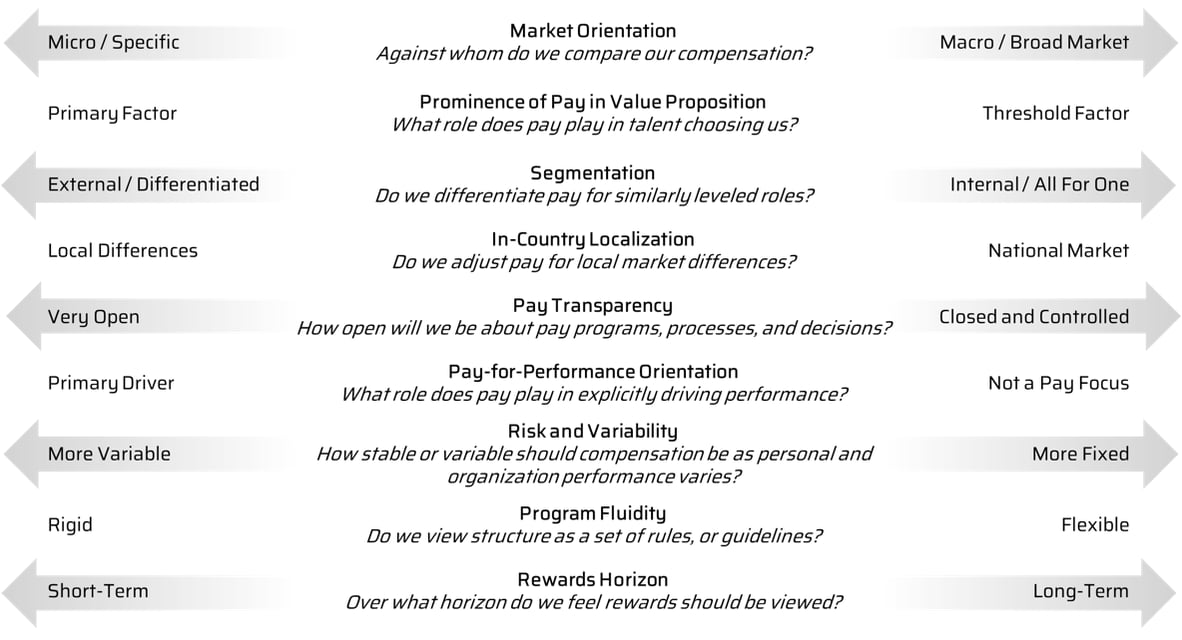
For Mesa Labs, getting both right wasn't just a design exercise. It was what made the market data meaningful — because once leadership could articulate not just where they wanted to pay but how they wanted to pay, the external benchmarks stopped feeling arbitrary and started feeling like confirmation.
Global Grade-Based Compensation Structure and Gap Assessment
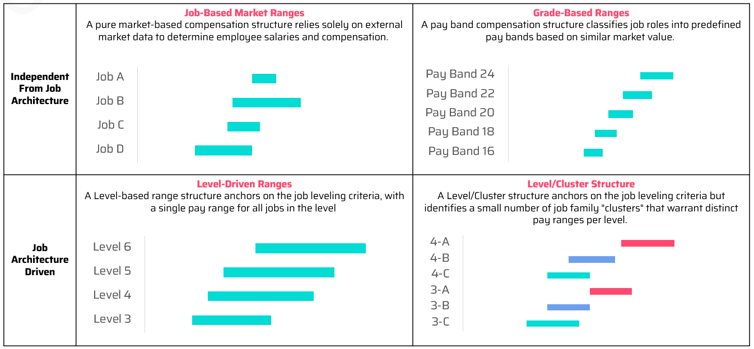
To bring order to a complex landscape, Novo Insights presented four core compensation archetypes — each with distinct trade-offs in flexibility, consistency, and administrative complexity. Rather than prescribing a solution, the team worked through how each model would perform against Mesa Labs' vision, workforce composition, and M&A trajectory.
Mesa Labs chose a global grade-based design, a structure that creates consistent pay decisions across roles and regions and is built to absorb future acquisitions without requiring a rebuild from scratch.
From there, Novo Insights built out the full global salary structure and extended the framework to include a global level-based bonus and equity target structure, ensuring total compensation was coherent and competitive across all roles and regions. The team also completed a comprehensive assessment of gaps, which surfaced where the structure might lean toward over- or under-paying relative to desired market positioning. The process also revealed opportunities to more clearly define career progression paths, resulting in additional job profiles that gave employees and managers a more legible framework for growth. Leadership now had not just a framework, but a financial roadmap for implementing it and a clearer picture of the talent infrastructure they were building toward.
Novo Insights' View: Compensation Structure Archetypes
Communication and Change Management Toolkit
Mesa Labs knew from first-hand experience that even the best design could fail without organizational buy-in. This time, adoption was engineered from the start, not bolted on at the end.
Novo Insights developed a suite of enablement tools calibrated to different audiences: an executive summary that gave leadership the narrative they needed to champion the change from the top, a Compensation Excellence Guide that equipped managers to answer the questions they'd inevitably face from their teams, and a curated FAQ that addressed employee concerns before they became objections.
When the new framework was presented, it didn't just get approved - it was embraced.
Key Insights
Why the Second Pass Succeeded When the First Didn't
The difference between Mesa Labs' initial stalled framework and the successful second attempt was not technical. It was relational. The first framework was built in relative isolation and presented as a finished product. The second was co-developed with leadership input, validated against real market data the team trusted, and rolled out with tools that made managers feel prepared rather than exposed. The result was more than a compensation structure. It was organizational confidence in the framework, in the data behind it, and in leadership's ability to explain and defend it.
Adoption Is Not a Phase at the End. It Is a Design Constraint from the Start
Mesa Labs had already learned what happens when a well-designed framework meets an unprepared organization. The second engagement treated adoption not as a rollout step but as a design input. Every structural decision, from the choice of a grade-based model to the scope of the gap assessment, was pressure-tested against whether managers and leaders could explain it, apply it, and stand behind it. That discipline is what separated a framework that got approved from one that got used.
That foundation did not end when the project did. Mesa Labs continued the partnership with Novo Insights through an embedded Compensation as a Service model, ensuring the framework stayed current, consistently applied, and ready to support the business as it grew.
Ready to turn your job architecture into a scalable compensation framework?