
.png?width=940&height=788&name=Our%20Client%20Promise%20(2).png)
Industry
Technology
Challenge
A global enterprise software company had recently implemented a job architecture and needed expert guidance to design a scalable, globally consistent compensation structure that could support rapid growth, varied functional market positioning, and evolving pay transparency requirements without relying on unsustainable, role-by-role market pricing.
Results
The client's Rewards team can now make consistent, defensible pay decisions across geographies and functions without pricing every role from scratch. With a scalable global framework in place, the organization is better positioned to attract top engineering talent at competitive rates, manage pay transparency requirements with confidence, and bring new markets online without rebuilding from the ground up each time.
Services
Compensation Foundations

About the Client
The client is a fast-growing global enterprise software company whose workforce nearly doubled in just a few years — a pace of growth that put significant pressure on people programs designed for a smaller, simpler organization. Recognized by industry analysts as a leader in multiple categories, the company helps organizations unify data and automate complex processes through low-code application development. With teams spanning multiple countries and a deliberate strategy to compete for top engineering talent, compensation was becoming a competitive differentiator, not just an administrative function.The Challenge
The client's Rewards team had recently built a job architecture using the Radford level descriptors model, fully implemented into their Workday environment. With that foundation in place, the organization turned to Novo Insights for expert guidance on designing a compensation structure to accomplish three key objectives.
To understand why getting this right mattered, it helps to appreciate what's actually at stake when job architecture goes unresolved.
Novo Insights' View: Compensation Structures Are What Activate a Job Architecture
Organizations invest significant time and energy into building job architecture and defining how work is categorized, how roles relate to one another, and what career progression looks like across levels. It is a meaningful foundation for a wide range of People programs.
While job architecture is a critical foundation for many programs, its most important expression is through the compensation structure. The compensation structure is what translates job levels and career frameworks into something tangible — the pay opportunity an employee sees when they're hired, promoted, or considering whether to stay.
As pay transparency becomes both a regulatory requirement and a competitive expectation, having a sound, consistent approach to managing pay opportunity across roles is no longer optional. It is the mechanism through which job architecture becomes real.
Ensure Scale as Growth Occurs
Prior to this engagement, the client was market pricing each role individually as it was created or deployed into a new market — providing guidance to HR and Talent Acquisition teams on a case-by-case basis. For high-volume roles like Software Engineers and Customer Success Managers, some bespoke ranges had been created, but one-off localization discussions were still required every time a hire occurred in a new geography. With a Rewards team of "One Plus", a dedicated Compensation Analyst supported by a Compensation and Benefits leader, this approach was unsustainable.
Accommodate a Global, Multi-Functional Workforce
The organization had expanded significantly across international markets and was making a deliberate investment in its India talent base. Without shared global compensation benchmarks, local norms were developing based on the preferences of local leaders — often defaulting to informal "percent of U.S. rate" shortcuts when making hiring decisions. At the same time, the organization wanted to ensure it could consistently attract talent across all functional areas while maintaining differentiated market positioning for specific roles. Competing for top engineering talent at a premium was a strategic priority, but the company did not feel it needed to pay all functions at that same premium level.
Support Evolving Pay Transparency
The client was complying with all applicable regulation, but had been taking a reactive approach. The inconsistency of posted pay ranges, a direct result of each role being priced separately, was beginning to create concern. Communicating pay opportunity to employees and candidates became increasingly difficult when ranges varied in ways that were hard to explain or defend.
The Solution
Philosophy Clarification
Novo Insights began by helping the client articulate a compensation philosophy that went beyond market positioning — facilitating an interactive workshop with key stakeholders to explore the organization's legacy, current, and desired future states across a full range of compensation trade-offs.
Novo Insights' View: A Compensation Philosophy Is Not a Set of Rules. It Is a Set of Principles That Inform Key Trade-Offs.
Most organizations have a compensation philosophy, but most philosophies only answer half the question.
Nearly every organization articulates a view on how much to pay: where they want to position themselves relative to the market. This is essential, but on its own it risks becoming a 'set it and forget it' exercise that sits in a policy document and shapes little of what actually happens day to day.
Far fewer organizations have a framework for how to pay: the principles that guide how pay programs are experienced by employees, how managers make decisions within them, and how the organization operationalizes its compensation intent in practice. This is where philosophy becomes culture, and where most frameworks quietly break down.
A compensation philosophy that answers both questions gives leaders genuine fluency with the tradeoffs they'll face, not just a number to anchor to.
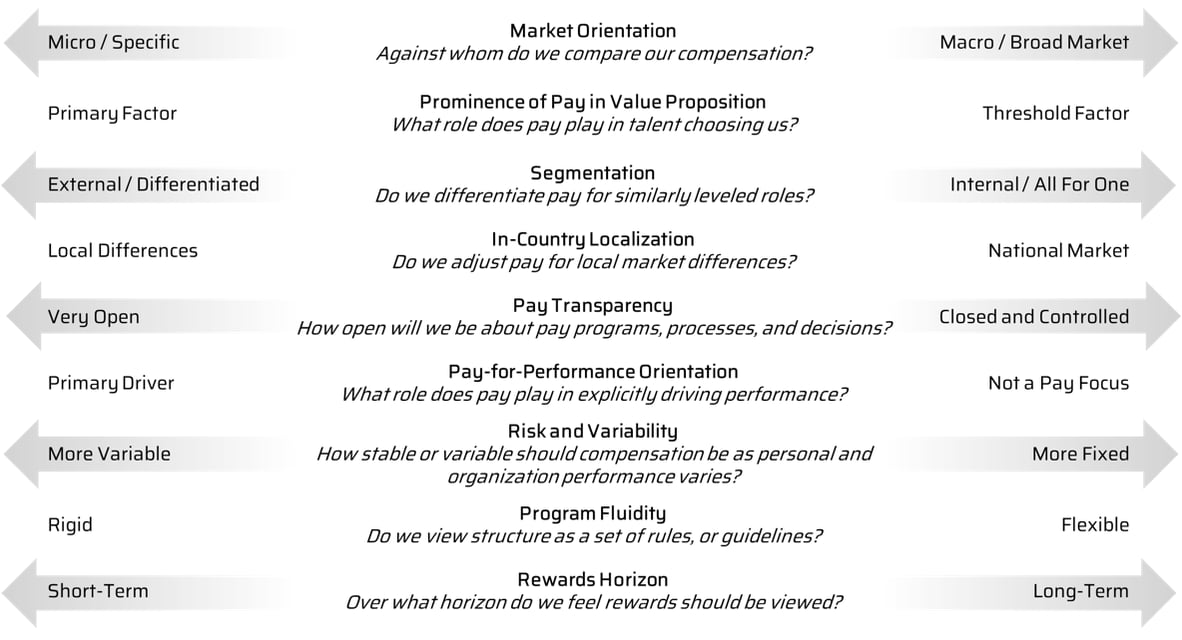
The output was a philosophy the organization could actually stand behind and use to make decisions, rather than a policy statement filed away after launch.
Global "Level/Cluster" Compensation Structure
With the philosophy established, Novo Insights presented four core compensation structure archetypes, each with distinct trade-offs in market precision, administrative complexity, and communication ease. Rather than prescribing a solution, the team worked through how each model would perform against the client's philosophy, workforce composition, and growth trajectory.
Novo Insights' View: Compensation Structure Archetypes
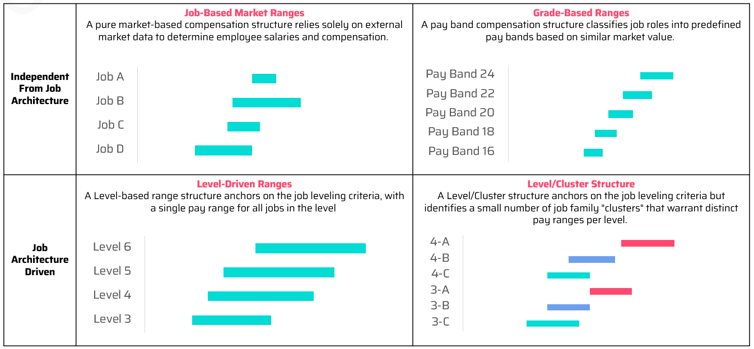
The client chose a Level/Cluster design, a structure that anchors pay ranges to job levels while allowing strategic differentiation across clusters of job families with similar market value. This approach reinforced the hard work the client had already completed on job leveling, while enabling differentiated market positioning for roles where it mattered most. The solution the client landed on was a blend: Sales was carved out as its own distinct cluster, while the remaining job families were organized into three clusters — low, mid-range, and high — based on market value. Four clusters in total, primarily driven by market competitiveness and ease of communication.
Impact and Pay Equity Analysis
Novo Insights conducted a rigorous analysis to test the structure against market data and the client's existing workforce. Using multiple analytical methods, the team assessed whether ranges were competitive, whether they created risks of systematic over or underpayment, and how well they fit the current population.
A pay equity review was also completed using Novo Insights' modeling tools, identifying any statistically significant disparities and ensuring compliance with U.S. OFCCP requirements.
Operational Readiness
Novo Insights helped the client prepare for execution in two critical ways. First, when turnover on the internal Rewards team created a resource gap mid-engagement, Novo Insights stepped in with fractional compensation expertise, working directly alongside HR to design a clear implementation path in Workday and ensure nothing was lost in the transition.
Novo Insights also developed comprehensive operational guidelines and playbooks covering salary ranges for job postings, promotions, internal transfers, and annual compensation cycles. The result was an HR team that didn't just receive a framework, they received the tools and knowledge to run it confidently on their own.
Key Insights
The Right Clustering Approach Depends on What You're Optimizing For
A key decision in designing a Level/Cluster compensation structure is how to group jobs within each level. The three main approaches — clustering by job group, job family, or individual job — each carry distinct trade-offs between administrative lift, communication ease, and market precision. For this client, a hybrid approach proved to be the best fit: carving out Sales as its own cluster based on its distinct market positioning, while organizing the remainder of the organization by job family. This choice reflected the client's priorities of market competitiveness where it mattered most, and simplicity everywhere else.
More Precision Comes at a Cost — Know Where to Draw the Line
The number of clusters per level is directly tied to the clustering approach chosen. More clusters deliver greater market precision but introduce additional administrative complexity. In practice, Novo Insights has found that beyond five clusters, the structure begins to resemble job-based market pricing, undermining the consistency and scalability that the Level/Cluster design is meant to provide. For this client, four clusters struck the right balance: precise enough to support differentiated market positioning, simple enough to communicate and sustain.
A Scalable Framework Requires Operational Readiness, Not Just Design
Designing a compensation structure is only half the work. Without a clear path to implementation and the operational tools to sustain it, even the most well-designed framework can stall. For this client, that meant navigating internal team transitions, building a Workday implementation roadmap, and creating playbooks that gave HR the confidence to manage the program day to day. The framework was built to scale — and so was the team's ability to run it.
Ready to turn your job architecture into a scalable compensation framework?